
Rodent control decisions in Pasadena are more complex than in many Southern California cities because of the prevalence of 100-year-old homes and the fact that rodents here are established at entering structures from both above and below ground.
On a single Pasadena property, it is common to document roof rats in attic spaces while Norway rats occupy attics, crawlspaces, ivy burrows, or slab-edge transitions below. Because these species can move through different structural pathways and landscape systems, traditional rodenticide bait and fertility-control bait solve different stages of the same problem rather than competing with each other directly.
Understanding where each method fits depends first on how rodents are using the structure.
Where Rodent Activity Typically Begins in Pasadena Homes
Pasadena supports stable populations of both primary commensal species.
Roof rats are commonly encountered:
- inside attic insulation cavities
- along fence-top travel routes
- in detached garage rafters
- beneath palm skirts
- within citrus canopy bridges
- inside bougainvillea hedge corridors
- along mature cypress windbreak rows
Norway rats are commonly encountered:
- beneath raised foundations
- along irrigation-softened slab edges
- inside retaining-wall void systems
- beneath ivy-covered burrow networks
- at crawlspace vent perimeters
- beneath detached garage slabs
During inspections of Pasadena homes built before 1930, it is common to document simultaneous attic-level roof-rat activity and subarea Norway-rat burrowing beneath the same structure. Norway rats are not limited to ground level activity though; we commonly find them in attics as well.
This vertical overlap is one reason single-method control strategies often produce only temporary results.
Why Pasadena Homes Are Especially Vulnerable to Dual-Species Pressure
Several recurring construction-era features allow rodents to establish above- and below-ground pathways at the same time:
- open rafter tails on Craftsman homes
- early attic vent retrofits with oversized screening
- raised perimeter foundations with soil-contact lattice transitions
- detached garages with exposed sill plates
- long-established ivy groundcover along foundations
- citrus canopy touching rooflines
In older homes built before 1950, crawlspace-to-landscape transitions are among the most common concealed Norway-rat access relationships.
We commonly see roof rats entering attic voids while Norway rats establish burrows directly below foundation vents screened decades earlier with wide-gauge mesh.
How Traditional Rodent Bait Functions in Pasadena Settings
Exterior rodenticide bait reduces active populations along established travel routes. In Pasadena properties, these routes most often include:
- fence lines between parcels
- detached garage perimeters
- alley-facing yard edges
- retaining-wall transitions
- crawlspace vent approach zones
During inspections, exterior baiting can reduce visible activity along these corridors within one to two weeks when placement follows confirmed movement pathways.
However, bait does not prevent reinfestation if structural entry points remain open. Removal of animals without sealing access routes allows replacement rodents to occupy the same void spaces quickly.
Professional programs in older Pasadena structures generally avoid rodenticide placement inside attics or wall cavities except where removal is otherwise impossible, because balloon framing and plaster wall construction frequently conceal inaccessible mortality locations.
Why Rodenticide Baiting Before Exclusion Is Not Recommended
Rodenticide placement prior to sealing entry points produces predictable outcomes in Pasadena’s historic housing stock.
Typical inspection findings after pre-exclusion baiting include:
- odor inside inaccessible wall cavities
- insect secondary infestations
- repeated attic reoccupation within one season
- shifting activity from attic to crawlspace zones
More importantly, open access routes allow replacement animals to enter immediately after population reduction.
During inspections of Pasadena homes built before 1940, attic reoccupation commonly occurs through original gable vent screening or open eave-return framing when exclusion has not yet been completed.
Effective sequencing follows this progression:
Remove existing attic occupants
Seal structural entry routes
Reduce surrounding breeding pressure
Homes that skip step two almost always experience recurrence regardless of treatment method. Because exclusion is typically performed before selecting a suppression strategy, it helps to understand where rodents typically enter older Pasadena and other west San Gabriel Valley homes.
How Rodent Birth-Control Bait Works in Pasadena Conditions
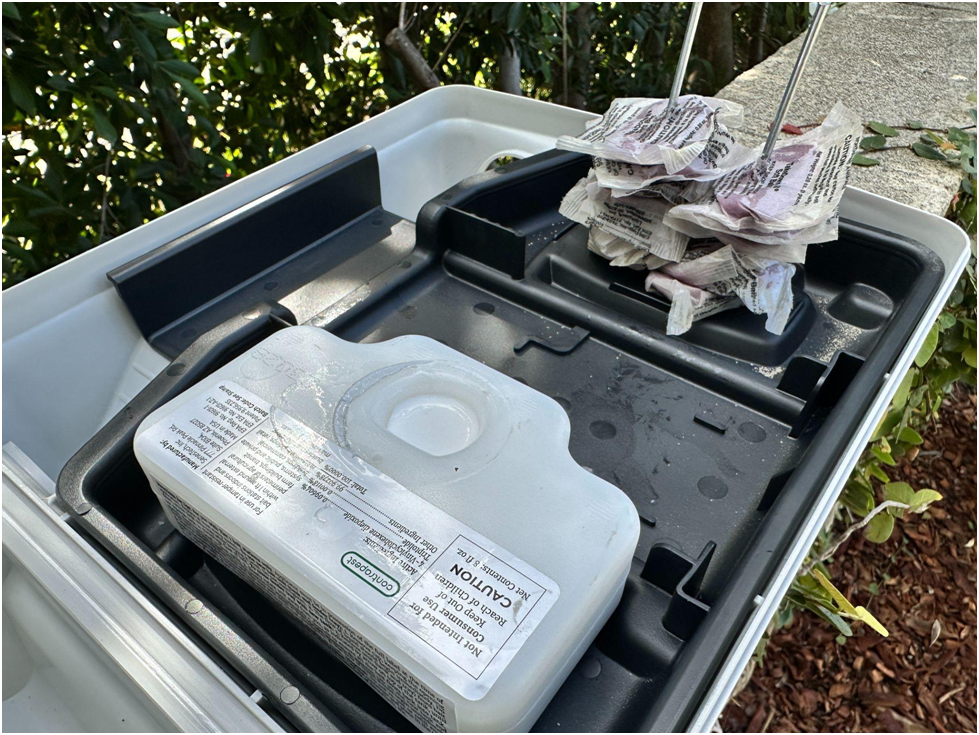
Rodent Birth Control bait reduces reproductive success rather than removing animals already present.
This humane approach affects both roof rats and Norway rats (as well as mice), but visible population decline depends on how connected surrounding habitat is between adjacent parcels.
During inspections, the earliest measurable changes are typically:
- fewer juvenile sightings along fence corridors
- reduced activity near crawlspace vent perimeters
- fewer new burrow starts along slab transitions
- decreased exploratory roofline movement after exclusion is complete
These changes reflect reduced recruitment rather than immediate disappearance of adult animals.
Why Single-Feed Rodent Bait Works Faster Than Fertility-Control Bait
Single-feed rodenticides are designed so that one feeding event can deliver a lethal dose. After consumption, neurological impairment typically reduces further feeding behavior, meaning continued bait access is not required for effectiveness.
Fertility-control bait operates differently. Instead of producing a lethal threshold response, reproductive suppression develops cumulatively across feeding events. The amount consumed influences the degree of fertility reduction rather than determining whether suppression occurs.
During inspections of Pasadena properties using fertility-control bait programs, reductions in juvenile recruitment are commonly observed before noticeable changes in adult movement patterns. This reflects successful suppression of reproduction rather than removal of established individuals.
Why Uneven Feeding Within a Colony Affects Fertility-Control Performance
Dominant individuals sometimes access bait stations repeatedly before subordinate animals feed. This pattern is especially common in Norway-rat burrow networks beneath ivy-covered foundation edges and retaining-wall terrace systems.
However, increased intake by a single animal does not reduce the biological effectiveness of fertility-control bait for that individual. Suppression increases with cumulative consumption rather than reaching a single-dose threshold.
The operational limitation is not overconsumption. It is uneven distribution across the breeding population.
During inspections of properties with continuous foundation-level habitat corridors, slower visible reductions are commonly associated with delayed access among subordinate animals rather than insufficient bait intake overall.
Why Colony-Level Exposure Determines Fertility-Control Success
Fertility-control bait reduces recruitment most effectively once a substantial portion of the breeding population has consumed it.
Across vertebrate fertility-control programs, visible population decline typically begins once roughly half of breeding individuals receive exposure. Below that level, reproduction slows but immigration from surrounding parcels can temporarily maintain activity levels.
During inspections in Pasadena neighborhoods with continuous ivy groundcover extending across multiple adjacent properties, this pattern is frequently observed where foundation-level burrow systems function as shared habitat corridors.
In contrast, canopy-connected roof-rat territories often show earlier visible change because feeding stations positioned along fence-top travel routes distribute access more evenly across individuals moving between parcels.
How Roof Rats and Norway Rats Respond Differently to Population Suppression
Both species are biologically affected by fertility-control bait. Differences in visible results come from movement patterns rather than susceptibility.
Roof rats depend heavily on elevated travel systems such as:
- citrus canopy bridges between parcels
- mature cypress windbreak rows
- bougainvillea hedge corridors
- palm skirt shelter zones
- detached garage rooflines
- overhead utility service lines
Because these pathways form linked but partially bounded territories, reduced reproduction often produces noticeable declines in seasonal attic investigation activity after exclusion is complete.
Norway rats depend primarily on ground-level shelter continuity such as:
- ivy-covered burrow systems along foundations
- irrigation-softened planting beds
- retaining-wall void transitions
- crawlspace vent perimeters
- detached garage slab edges
Because these subgrade systems often extend beneath multiple parcels, animals regularly move between properties through concealed soil-level corridors. Fertility-control placement still suppresses local reproduction, but visible reductions may appear more gradually when immigration from surrounding burrow networks continues.
This does not reduce the biological effectiveness of fertility control—it changes how quickly population decline becomes visible at a single property.
Why Using Rodenticide and Fertility-Control Bait Together Works Better in Pasadena Homes
Combined placement of lethal bait and fertility-control bait influences both current occupancy and future recruitment.
Rodenticide reduces the number of animals actively occupying structural and landscape pathways.
Fertility-control bait reduces the number of replacement animals entering those pathways in subsequent breeding cycles.
During the interval between lethal bait consumption and mortality, affected rodents are typically not successfully reproducing. Continued exposure among surviving individuals further suppresses recruitment across successive cycles.
During inspections of Pasadena properties with both canopy-level travel routes and foundation-level burrow continuity, the most stable reductions in recurring activity are commonly observed where both bait types are deployed along separate movement pathways.
Why Some Rats Ignore One Bait but Eat Another
Variation in feeding preference between individual rodents influences how widely bait exposure spreads across a population.
Roof rats traveling along citrus canopy bridges, fence-top routes, and detached garage rooflines often encounter elevated placements first. Norway rats approaching crawlspace vent perimeters, slab transitions, and ivy-covered foundation runs typically encounter ground-level placements earlier.
Providing more than one bait formulation increases the likelihood that a larger portion of the breeding population encounters at least one acceptable food source.
During inspections of Pasadena properties with detached garage corridors and ivy-lined side yards, improved coverage is commonly associated with distributing bait types across both elevated and foundation-level travel routes.
Does Rodent Birth Control Still Work If Rats Keep Coming From Neighboring Properties?
In neighborhoods with shared burrow continuity between adjacent parcels, immigration can temporarily maintain visible activity levels even after reproduction declines locally.
This does not reduce the biological effectiveness of fertility-control bait. It changes how quickly reductions become visible at a single property.
Over successive breeding cycles, recruitment declines across connected territories as more individuals encounter treated bait stations along travel corridors.
During inspections of Pasadena homes with long-established ivy along foundation lines, the earliest indicators of successful deployment are typically reductions in juvenile burrow openings rather than immediate disappearance of adult movement.
Why Station Placement Determines Fertility-Control Results in Pasadena Homes
In Pasadena housing conditions, the distribution of bait stations along travel pathways typically determines outcome more strongly than the specific bait selected.
Effective placement commonly includes:
- fence-line transitions between parcels
- detached garage approach zones
- crawlspace vent perimeters
- retaining-wall edges
- citrus canopy contact points
- ivy-covered foundation runs
During inspections, slower population suppression is most often associated with stations concentrated in a single portion of the property rather than distributed across multiple structural travel corridors.
How Long Rodent Birth Control Takes to Reduce Rodent Activity in Pasadena Homes
After structural exclusion is complete, fertility-control placement typically produces the following progression:
First breeding cycle
juvenile sightings begin declining
Second breeding cycle
fewer exploratory roofline investigations occur
Third breeding cycle
new burrow formation decreases along slab transitions and crawlspace vents
These changes reflect reduced recruitment rather than removal of adult animals already occupying surrounding habitat corridors.
Over time, this shift produces fewer seasonal attic entry attempts and fewer recurring foundation-level excavation sites even in neighborhoods with continuous vegetation connectivity between parcels.
Can Rodent Birth Control Replace Rodenticide in Pasadena Homes?
Rather than replacing rodenticide directly, fertility-control bait replaces the need for repeated population knockdown treatments by reducing juvenile recruitment across successive breeding cycles. In neighborhoods with continuous vegetation corridors or foundation-level habitat continuity between parcels, this shift often produces more stable long-term control than lethal baiting alone.
Fertility-control bait reduces future recruitment.
In Pasadena housing conditions where both roof-rat canopy travel and Norway-rat burrow continuity occur simultaneously, long-term stabilization typically depends on combining exclusion with population-pressure reduction rather than relying on a single bait type alone.
Once structural access routes are sealed, fertility-control bait functions as a long-term exterior management strategy that reduces seasonal reinvestigation pressure and limits the number of replacement animals entering the property over successive breeding cycles.
Which Approach Works Better for Most Pasadena Homes?
In Pasadena housing conditions, the most reliable long-term strategy follows a sequence rather than relying on a single method:
1. Seal structural entry routes while simultaneously trapping interior occupants
2. Eliminate conducive conditions where possible
3a. Optional: Provide quick knockdown with lethal baits or extensive protected trapping
3b. Reduce breeding pressure
The extent of sealing required varies by structure age and roofline complexity, which is why many Pasadena property owners review what exclusion typically costs before choosing when to implement the above steps.
Exterior baiting can reduce active movement along confirmed travel corridors when necessary, but long-term stability depends on closing entry pathways and lowering recruitment in surrounding habitat.
Because Pasadena properties frequently support both roof-rat canopy movement and Norway-rat subgrade burrow continuity at the same time, fertility-control placement functions best as a post-exclusion population-pressure management tool rather than a substitute for structural protection.
On properties where rodents are actively damaging vehicles, irrigation systems, stored materials, or garden areas, a distributed placement strategy is often appropriate. In these cases, lethal bait may be positioned along high-risk travel corridors near specific damage zones, while fertility-control bait is deployed more broadly across fence lines, foundation transitions, and landscape pathways to reduce reproduction across the surrounding population.
Rather than concentrating multiple bait types inside a single station, separating placements by function allows urgent suppression where immediate protection is needed and longer-term recruitment reduction across the remainder of the property. This approach is commonly used in Pasadena neighborhoods where both canopy-connected roof-rat movement and foundation-level Norway-rat burrow systems are present at the same time.
